Blog

New Edition of Waite’s David Joris and Dutch Anabaptism (Pandora Press, 2026)

New Edition of Waite’s David Joris and Dutch Anabaptism (Pandora Press, 2026)
Front cover of Gary Waite, David Joris and Dutch Anabaptism, 1524-1543 (Hamilton: Pandora Press, 2026).
Version 1.0.0

David Joris and Dutch Anabaptism, 1524-1543. 2nd Edition.  

Pandora Press, 2026

Paperback – published March 30 2026 

by Gary K. Waite 

Volume 14 of the Anabaptist and Mennonite Studies Series

Order here: https://www.amazon.ca/dp/1778730485

“With this re-release of his pioneering study of David Joris and Dutch Anabaptism, Gary Waite shows that the Devil is quite literally in the details – and much more besides. Waite appends a sweeping and authoritative survey to the original text in order to demonstrate how the field has grown radically since the book’s appearance in 1990. He shows how works on demonology, on the history of emotions and of the senses, on the Jews and mysticism, on language, humanists, rhetoricians, and witches have all shifted the historiographical landscape. Joris’s own radicalism gains even greater fluidity, with Waite following the currents – perhaps waves — that move it towards anabaptism, spiritualism, and libertinism. By pairing the original text with an extended review of the research which he and others have carried out over the past forty years, Waite paints a far richer portrait of this complex character who was much loved and greatly reviled, and whose visionary view of a religion free of compulsion is more compelling now than ever.” 
—Nicholas Terpstra, University of Toronto

Originally published in 1990 by Wilfrid Laurier University Press, and reprinted in 2025 by Pandora Press with a new preface and supplementary chapter by the author, Gary Waite’s biography of David Joris is still the most comprehensive scholarly treatment of Joris’ life and thought.

Gary K. Waite (PhD, Waterloo, 1987) is Professor Emeritus at the University of New Brunswick and a Fellow of the Royal Society of Canada. His research has focused on the religion and culture of the early-modern Netherlands, beginning with the Dutch Anabaptist and Spiritualist David Joris (c.1501-1556). Waite has also published extensively in the fields of demonology and the witch-hunts (see his Eradicating the Devil’s Minions: Anabaptists and Witches in Reformation Europe, 1535-1600 of 2007) and the religious “other” (Jews and Muslims in Seventeenth-Century Discourse: From Religious Enemies to Allies and Friends of 2019). His most recent publications arise from the Amsterdamnified! research programme on the radical religious roots of the early Enlightenment: Anti-Anabaptist Polemics: Dutch Anabaptism and the Devil in England, 1531-1660 (2023), and the co-edited Spiritualism in Early Modern Europe, in Church History and Religious Culture (101, 2021). With Lisa M. Todd, he is also co-editor of European Racism: A History in Documents (2024).

Praise for David Joris

…impressive.”

—Douglas H. Shantz, in Renaissance and Reformation

“…refreshing.”

—Paul H. Friesen, in Method & Theory in the Study of Religion

“…a major contribution.”
—Lee Daniel Snyder, in Church History

“With this re-release of his pioneering study of David Joris and Dutch Anabaptism, Gary Waite shows that the Devil is quite literally in the details – and much more besides. Waite appends a sweeping and authoritative survey to the original text in order to demonstrate how the field has grown radically since the book’s appearance in 1990. He shows how works on demonology, on the history of emotions and of the senses, on the Jews and mysticism, on language, humanists, rhetoricians, and witches have all shifted the historiographical landscape. Joris’s own radicalism gains even greater fluidity, with Waite following the currents – perhaps waves — that move it towards anabaptism, spiritualism, and libertinism. By pairing the original text with an extended review of the research which he and others have carried out over the past forty years, Waite paints a far richer portrait of this complex character who was much loved and greatly reviled, and whose visionary view of a religion free of compulsion is more compelling now than ever.” —Nicholas Terpstra, University of Toronto

“Waite’s biography of Joris concentrates on his career as a Dutch Anabaptist instead of his later, better-known activity as a Spiritualist in Basel. Waite argues convincingly that, from 1536 to 1539, Joris was the most influential Anabaptist leader in the Netherlands. Adopting a middle path between the revolutionary chiliasm of the Munster Anabaptist kingdom and the radical separatism of Menno Simons and his flock, Joris sought to unite the splintered Melchiorite movement under his leadership… This book has important implications for our understanding not only of Joris but also of northern German and Dutch Anabaptism.” —Geoffrey Dipple

“This new edition of Gary Waite’s important 1990 study on David Joris enriches what was already a ground-breaking publication with the latest research updates on Joris, many of which are from Waite’s own impressive body of publications over the last 35 years. This edition also provides a historiographical update to findings within the broader field of early modern Anabaptist studies and related early modern European religious history in the past several decades. Waite uses the new 100+ page preface to emphasize some concepts that were already present in the original version but that he has come to see as even more significant than he had initially indicated back in 1990; he also adds in new insights on Joris and his context, and takes the opportunity to make some corrections and adjustments to past assessments. The preface alone serves as an excellent introduction not only to the book, and to Joris, but it also provides an accessible start into the conversation for a new generation of readers, and offers the latest academic perspectives (including both methodological and factual updates) on Joris, his networks, and their early modern religious contexts.

Joris was deemed a heretic by the orthodox establishment and even pejoratively called the Devil of Delft by some – which is ironic, since Joris’s spiritualist beliefs led him to dismiss the concept of a physical devil and instead understand evil as something internalized within the individual. In this volume’s new chapter on Joris’s distinct demonology, Waite explores all of this in detail. 

Though it was controversial, Joris’s theological work had an extremely long reach, influencing writers and thinkers among some circles of Mennonites and also many free thinkers of other creeds for centuries after his lifetime. His spiritualist approach to Christianity, which places minimal emphasis on the material trappings of religious practice, is a significant lasting legacy of his reforming work, and one well worth understanding for both historians and theologians today.”

—Nina Schroeder van ‘t Schip, author of Mennonites and Art in the Dutch Republic: Church Home and Art Marketplace (Pandora Press, forthcoming)

New Book 2023

New Book 2023

Gary K. Waite, Anti-Anabaptist Polemics: Dutch Anabaptism and the Devil in England, 1531-1660 (Hamilton: Pandora Press, 2023)

From the Book jacket comments: Dr. Michelle D. Brock (Washington and Lee University) — “This compellingly written book surveys anti-Anabaptist polemics in England from the Reformation to the Restoration. Waite deftly analyzes a wide range of printed texts to reveal the English attitude toward and caricature of ‘radical’ reform movements in continental Europe. Yet this book is about much more than the use of Anabaptism as a rhetorical cudgel carved for various purposes over the course of the sixteenth and seventeenth centuries. Instead, what Waite offers is a new window into the power — and unintended consequences — of fear, paranoia, and print in an age of demonization as much as reformation. Anti-Anabaptist Polemics is essential reading for scholars interested in the early modern polemics of hate and how they speak to our own moment of polarization and extremism.”

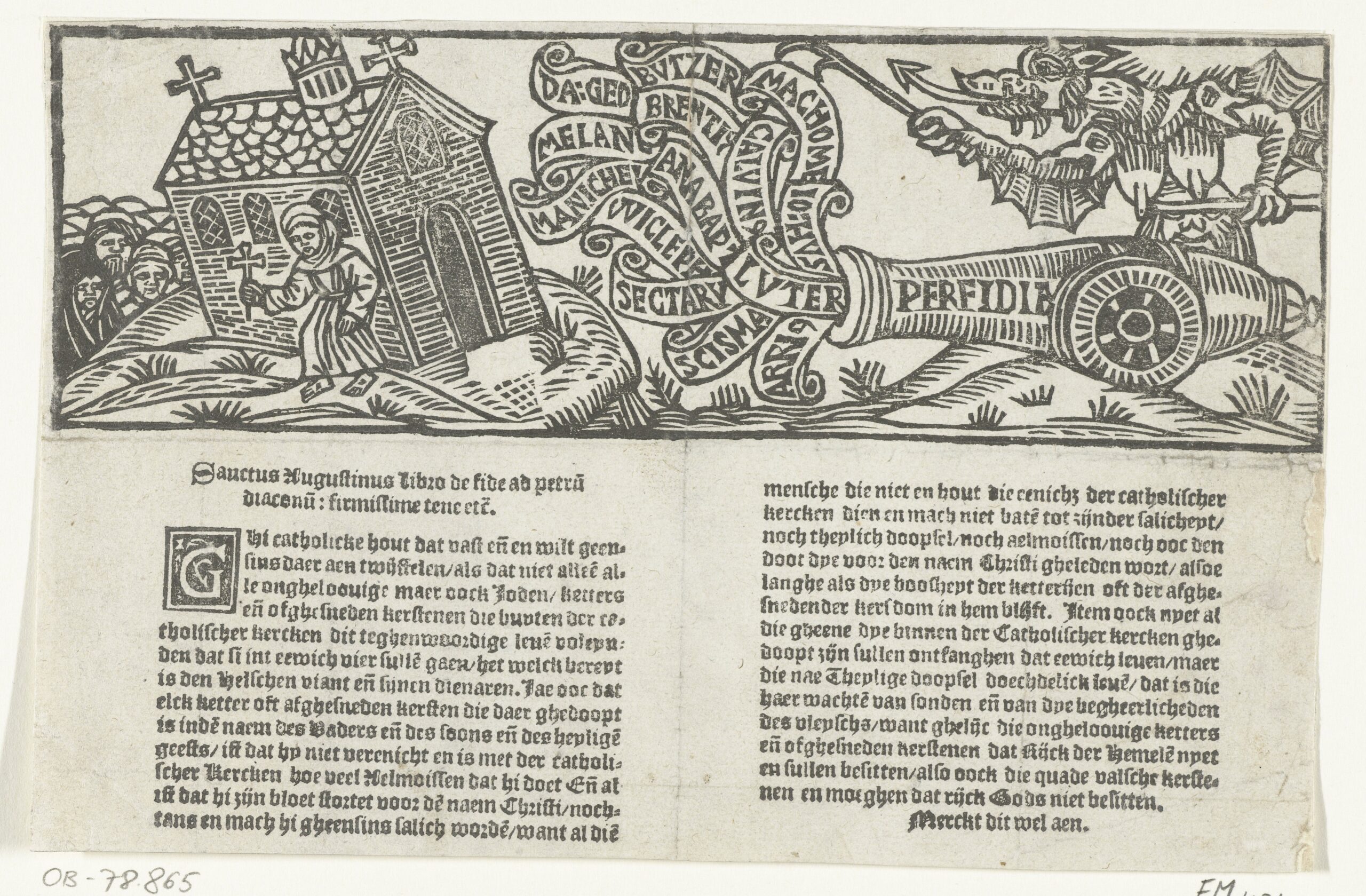
“The Devil Shoots Heresies at the Church”: About the Amsterdamnified Banner Image

“The Devil Shoots Heresies at the Church”: About the Amsterdamnified Banner Image

For more details about the banner image of “The Devil Shooting Heresies at the Church” (ca. 1560s), see Michael Driedger and Gary Waite (together with Francesco Quatrini and Nina Schroeder), “From ‘the Radical Reformation’ to ‘the Radical Enlightenment’? The Specter and Complexities of Spiritualism in Early Modern England, Germany, and the Low Countries” in Church History and Religious Culture 101:2-3 (July 2021), 135-166.

SOURCE: Rijksmuseum Amsterdam, public domain (https://www.rijksmuseum.nl/en/collection/RP-P-OB-78.865)

NEW: Special Issue of CHRC

NEW: Special Issue of CHRC

We are pleased to announce the publication of a Special Issue of Church History and Religious Culture (101: 2-3) that will be released in late July 2021. The theme is “Spiritualism in Early Modern Europe.”

The collection features essays by Theo Brok, Michael Driedger, William Cook Miller, Francesco Quatrini, Nina Schroeder, Anselm Schubert, Christine Schulte am Hülse, Nigel Smith, James Stayer, Stefano Villani, Hans de Waardt, and Gary Waite. The guest editorial team consists of Driedger, Quatrini, Schroeder, and Waite. In addition to spiritualist cultures among Protestants in post-reformation England, Germany, and the Low Countries (approx. 1521-1721), the collection will be of interest to scholars of religious dissent and nonconformity, the variety of ways that researchers discuss “radicalism” in early modern religious cultures, and the debates about “the Radical Reformation” and “the Radical Enlightenment.”

You can link to the Special Issue by going to https://brill.com/view/journals/chrc/101/2-3/chrchttps://brill.com/view/journals/chrc/101/2-3/chrc.101.issue-2-3.xml. There you can find free downloads of the Special Issue introduction, plus several other Open Access articles. All of the other articles are available to CHRC subscribers, and the articles will soon be available through university library connections (after the embargo period).

The collection began at a symposium in Amsterdam in the summer of 2019. Other symposium contributors who have published related work in other venues and are therefore worthy of special attention from readers of this collection are:

We recommend their work highly!

The guest editorial team would like to thank the journal’s editors and production staff (Ward Holder and Dieuwertje Kooij in particular) for their work in guiding this collection from a proposal to publication!

Amsterdamnified! A brief project description

Amsterdamnified! A brief project description

In 1641 an English Puritan complained that his country was being “Amsterdamnified” as laypeople presumed to speak authoritatively on religion. This new research program will explore how a growing public discourse on religion and philosophy in England was greatly influenced by the many heterodox groups that for decades had flourished in Amsterdam and other cities of the Dutch Republic. It will reveal how their debates significantly challenged and reshaped traditional beliefs on the eve of the Enlightenment, especially on the critical questions of the interpretation of the scriptures and the natural world. They also encouraged inter-confessional dialogue and crafted new forms of social organization. Led by ordinary urbanites, these interrelated groups included Dutch Doopsgezinden (aka Mennonites), English Baptists, spiritualistic Familists, anti-Trinitarian Socinians and English Quakers, to name a few. In the Dutch Republic some met together formally in the gatherings of the Collegiants and reached out to Amsterdam’s Jews. They viewed innovation positively thanks to an approach to religious identity known as spiritualism which emphasized the personal inspiration of the Holy Spirit over the letter of scripture; some – including a number of Mennonites – went so far as to deny the existence of a creaturely devil, a key marker of Enlightenment thought.

It is therefore important to examine the kind of “Amsterdamnified” freethinking leading up to the groundbreaking publications of Baruch de Spinoza (d. 1677) whose rational critique of revealed religion was formulated within Amsterdam’s climate of religious variety, interaction and debate. When in 1656 Spinoza was expelled from his synagogue he sought out such Collegiant-Mennonite nonconformists to assist him to push for toleration and individual liberty. Utilizing a social history of ideas approach, this research program explores how elements of the innovative ideas of Spinoza and other Enlightenment philosophers were drawn from these radical religious groups. This will require analysis of dissenter publications from both Holland and England and careful delineation of their interactions, readership and publisher networks; for example, Spinoza’s major publisher, Jan Rieuwertsz, was a Mennonite. It will detail the changing reception of nonconformist writings and reveal the changes in attitudes that assisted the crumbling of a providentialist worldview, the promotion of religious accommodation and experimentation with new forms of social and political organization.

Email group: “Spiritualist scholars network”

Email group: “Spiritualist scholars network”

Spiritualist scholars network

As part of our Amsterdamnified! Project, we are seeking to collaborate with other scholars who are working in the area of spiritualism and spiritualists in Early Modern Europe. To do so, we have created an email listserv, and invite all interested scholars and graduate students interested in the subject to join this virtual research group, simply by emailing waite@unb.ca.

Our goal is to begin discussions, raise research questions and seek answers, and provide a forum through which to push research and discovery in the field. We may do this by email, or we may switch to a FaceBook group or blog, perhaps through the Amsterdamnified! website, but those decisions will be made by the group. We can also discuss plans for meetings, symposia, or conferences.

The Amsterdamnified! Team is exploring spiritualism within a wide array of groups and individuals, to trace their personal, correspondence, and publishing networks, and see how the attitudes and approaches of particular writers/groups (Franck, Schwenckfeld, Joris, H. Niclaes & Familists, Coornhert, Castellio, liberal Doopsgezinden, Quakers, etc.) were taken up by others, reshaped, disseminated and utilized.

If you are interested in joining the Spiritualist listserv, simply email Gary Waite with a request to join: waite@unb.ca


Reading John Taylor’s 1641 pamphlet using Voyant Tools

Reading John Taylor’s 1641 pamphlet using Voyant Tools

Taylor1870“Amsterdamnified” was a neologism created by the prolific English poet, public relations pioneer and pamphleteer John Taylor (1580-1653) in a short 1641 pamphlet, Religions enemies. Taylor was a defender of the King and tradition who engaged enthusiastically in the pamphlet wars that were growing quickly in the early 1640s in the battles between King and Parliament. On the 6th and final page of Religions enemies Taylor wrote that “Religion is made a Hotch potch, and as it were tossed in a Blanquet, and too many places of England too much Amsterdamnified by several opinions….” To learn more about Taylor and the context for his pamphlet, see the bibliography at the end of the post.

Taylor is worth highlighting in large part because he provided a clear, effective statement of a very widely held 17th-century view on the dangers of innovation, diversity and toleration. In addition to Religions enemies, he also wrote a large number of other noteworthy works. We are including title page images from two more pamphlets from about the same period as the 1641 pamphlet that is the focus of this post (note that Taylor reused the image from Mad fashions in his more famous 1647 pamphlet The world turn’d upside down). All three images are from the 1870 edition of Taylor’s works.

The longer title of Religions enemies and its image highlight Taylor’s concerns with social and religious innovation. An additional handwritten note on the title page of the copy at the British Library (not shown here) was added by a 17th-century reader to summarize the source of danger he was decrying in Religions enemies. According to the additional note the enemies of religion were “all Independents”.

After this initial introduction and a first look at Religions enemies, readers might assume that Taylor devoted most of the text to an attack on and analysis of the various groups he thought endangered Christian social order. Is this the case? What is the text about?

These kinds of very general questions face all readers when they first open up a new text. If you have a digital version of a text at hand, one way to read it initially is to use computer tools for visual text analysis. A cirrus (aka word cloud) is one such tool. Wordle is one web program for this purpose. I prefer Voyant Tools, in comparison to which Wordle is a toy not a tool. Here is a Voyant frame with a cirrus of Religions enemies (note that stop words have not been excluded; but by moving your cursor over the right-hand corner of the frame you can choose the options and set stop words):

One of the particularly valuable features of Voyant Tools is that the program allows any reader of this Blog to analyze Religions enemies quickly and effectively by hovering over key words and clicking on the ones that might be most significant. A new window with a variety of analytical frames should open up for you. Try it!

You can experiment with the analytical options in Voyant. To learn more about the various tools available, go to Stéfan Sinclair’s page on “The Rhetoric of Text Analysis.”

In an earlier version of this post I included an interactive Voyant frame of the links tool for Taylor’s 1641 text. That frame is not working well since Voyant Tools has been updated. Below is a screenshot of the output I made with the earlier version of Voyant’s links. As with the word cloud, the relative size of each term indicates its frequency in the text. The lines linking words indicate how they cluster together in the text.

Taylor-ReligionsEnemies-Links

There is no substitute for a close reading of any text, but I believe that the visual, interactive summaries of the Voyant windows are valuable in part because they are an attractive, intriguing invitation to further and deeper reading. On the substantive level, these kinds of visual summaries are also a useful way to prepare for a more detailed examination of the text. The evidence from the word cloud and word links suggests a more complicated picture than the one that I sketched out after first introducing the text and presenting the title page. For example, we can all recognize immediately that “church,” “God,” “true” and “Christ” are the most frequent terms. Presumably, they — not heresy — are the primary subjects of the pamphlet. Is this the case?

An obviously important task for a close reading is figuring out how Taylor defined “church.” To help answer this question, we could use the contexts tool (previously called keywords in context [KWIC]). Here’s a screenshot of a contexts output from Taylor’s 1641 text.

Created with Voyant Tools, 23 Nov. 2017

When we look a little more closely at the analytical frames, we can also notice that the next tier of frequent terms (e.g., “bishop,” “physician,” “lawyer,” “law,” “government,” “body,” “preservation”) seems to be about the management of a healthy body-politic. Did Taylor subscribe to an organic picture of society? How much space in the text is actually devoted to dissenters? In the visual, symbolic “language” of the title page, perhaps the actual subject of the pamphlet is not the figures on the four corners of the blanket but rather the Bible in the middle of it? In just a few minutes we can gather a richer collection of questions and hypotheses to consider when reading the text more carefully. In short, Voyant is a great aid to close reading because it can encourage more active, thoughtful reading.

Of course, we should acknowledge the limitations of these visualizations. The visualization tools do not help us understand Taylor’s specific ideas, unless we also make the effort to use the tool to guide us to places in the text where we can read more closely. Furthermore, some significant terms might slip through its filters. Glancing through the entire text (which is conveniently short) you might notice that Taylor used a wide variety of terms for religious deviants. Because they are not repeated, Voyant does not highlight them, even though they might collectively be quite significant. After our pre-reading, however, we should have enough questions in our minds to notice the significance of these varying terms as we read through the text more carefully.

Another limitation is that you need a clean digital text that you can insert into Voyant or another visual analysis tool. Arranging such a text sometimes takes some effort. You can find a digital version of the Works of John Taylor in an online digital version through archive.org. I am including a cleaned up version here; you can use this text to try out other tools available through Voyant Tools. Note that I have edited the text of Religions enemies to correct scanning mistakes and modernize spelling in case the older, inconsistent spellings interfere with the Voyant analysis. Another important detail is that I have added “hath” and “shall” to the standard Voyant English stop word list before I linked the analytical frames to this page. But note: If you wanted to analyze Taylor’s use of language, it might be important to include all of these words (including stop words).

Please note that Voyant Tools works best on a desktop or laptop computer rather than a mobile device.

One last note: Special thanks to Keith Grant, a PhD candidate at the UNB-Fredericton, for originally pointing Gary Waite and me to Taylor’s text.

ONE LAST, LAST NOTE: This post was last updated on 23 Nov. 2017.


REFERENCES

Bernard Capp, The World of John Taylor the Water-Poet, 1578-1653 (Oxford: Clarendon, 1999).

Bernard Capp, “John Taylor ‘the Water-Poet’: A Cultural Amphibian in 17th-Century England,” 11:1 (1989): 537-44.

David Cressy, “Revolutionary England 1640-1642,” Past & Present, no. 181 (November 1, 2003): 35–71.

Tim Harris, “Charles I and Public Opinion,” in The Nature of the English Revolution Revisited, ed. Stephen Taylor and Grant Tapsell (Woodbridge: The Boydell Press, 2013), 1-25.

David Loewenstein, Treacherous Faith: The Specter of Heresy in Early Modern English Literature and Culture (Oxford: Oxford UP, 2013).

John Taylor, Works of John Taylor, the Water Poet, Not Included in the Folio Volume of 1630 (Manchester: The Spenser Society, 1870).


NOTE: This post was last updated on 23 Nov. 2017.